
Consider this familiar scenario. A new request lands in the resource manager’s inbox – a priority project for an important client has just received budget approval and needs to be staffed yesterday. The resource manager has to quickly find a solution. They already have someone in mind – someone who is a very strong performer, the correct grade and known for their work with that client. They check and yes – that person is available to be staffed on the project! Crisis averted!
On the surface, this is a win – a genuinely good fit for a high profile project; the client is happy and the next time a similar project comes along they request the same resource, so staffing that person becomes the fast, safe, defensible choice. The problem isn’t the decision. After all, the resource matches the criteria and is a genuine good fit. It is what happens when the same decision is made again, project after project.
The Hidden Cost of Staffing Who You Know
When it comes to staffing projects in large organisations, it is sometimes quite easy to fall back onto decisions that have been successful before. Each time that person gets staffed, they become slightly more visible. They are the name that resource and engagement managers remember: proven quality of work, low-risk, easy to plug in; or they may be more vocal in putting their hand up for available opportunities. Over time, that visibility compounds into something closer to a reflex where managers reach for who they know rather than taking a step back to see who is actually the best fit, simply because the rest of the workforce never enters the conversation.
It is rarely a conscious choice. Rather, it is a consequence of the information managers are actually working with. Most resourcing decisions are made under tight deadlines using fragmented data – a manager’s own network, recent project history, whoever happens to be top of mind that week based on fit and availability.
Three patterns show up again and again once you start looking for them:
Visibility bias. Managers default to consultants who have done similar work before, who they work closely with, or who are simply louder about wanting the opportunity. It’s the path of least resistance for a niche requirement: staff someone you already trust to deliver, rather than hunting through disconnected spreadsheets for an equivalent skill set you didn’t know existed.
Narrow economics. A request rarely arrives with full context attached. An engagement manager pushing to staff their preferred consultant for a valuable client relationship, high billable hours, or simply because that person is vocal about the opportunities they want, is not necessarily wrong. But it might not be the best use of that person across the whole portfolio.
Safe over stretch. A proven track record beats a stretch opportunity almost by default, because the safe pick carries less short-term risk. But that calculus often misses its own economics: it can mean burning a senior, expensive resource on work a developing consultant could grow into at lower cost, while quietly denying that person the experience they need to get there. It also results in lack of development opportunities for individuals who have the right skills set, but are less likely to put their hand up.
Why Familiarity Doesn’t Scale
When we think about resourcing at a smaller scale, or a more generalist skill requirements, this way of working can hold up fine. It breaks down as firms grow their workforce and the skills requirements become genuinely niche. At that point, staffing decisions that only draw on limited information or proximity bias are not just imperfect, they are statistically unlikely to find the best available fit. Seeing the workforce as a whole stops being a nice-to-have and becomes the only way to actually optimize across skills, availability, and cost at once.
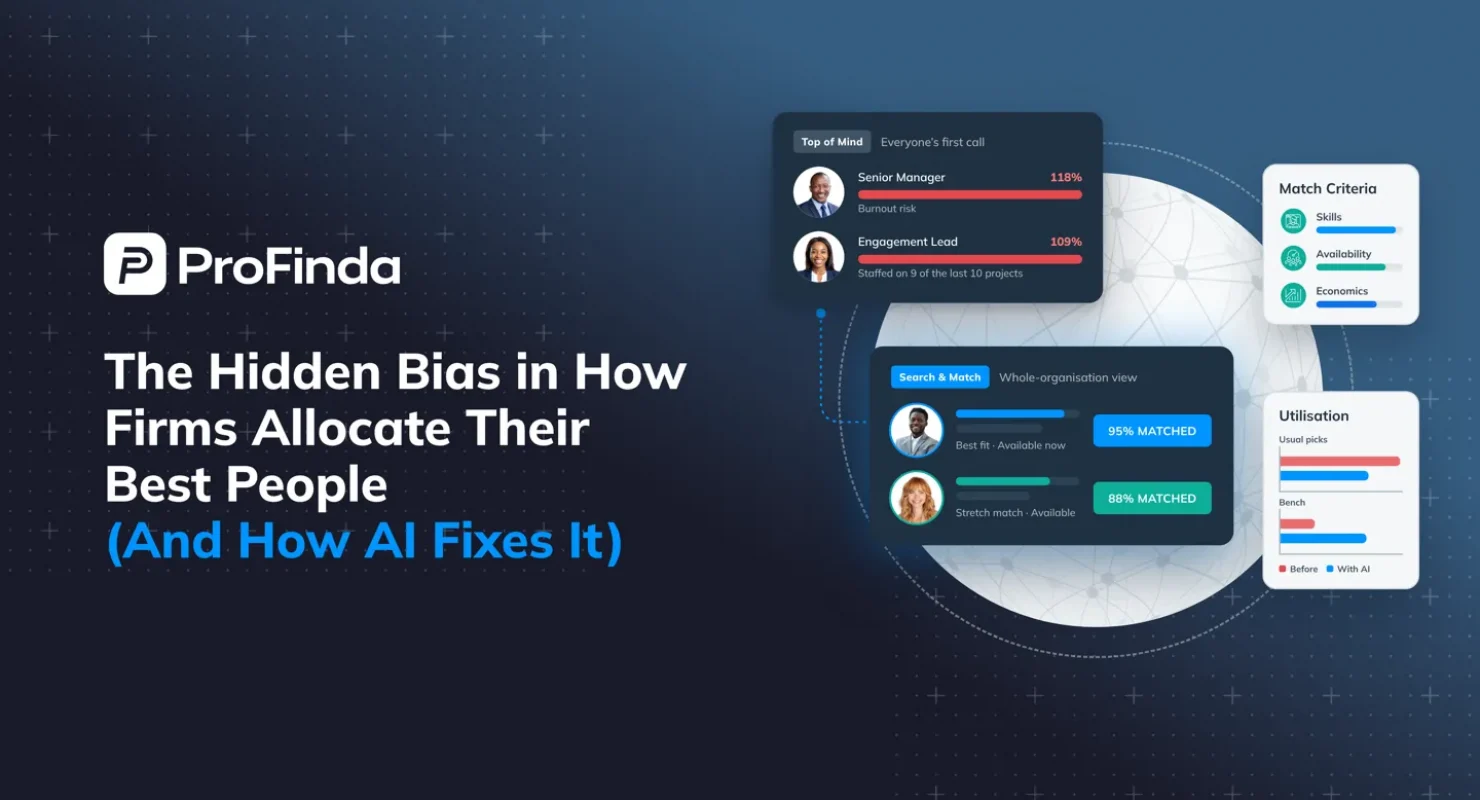
The compounding cost for the workforce isn’t abstract, either. The consultants who keep getting staffed because they are top of mind and have done similar projects are frequently the same people running the highest risk of burnout, stretched thin because they’re everyone’s first call. Meanwhile, people with comparable skills who simply aren’t as visible sit further down the bench, at real risk of disengagement and attrition. Not because they lack the ability, but because they were never in the room when the decision was made. Relying on proximity and familiarity doesn’t just introduce bias. It quietly erodes the workforce from both ends at once.
How AI Breaks The Familiarity Loop
The fix isn’t asking managers to be more vigilant about their own blind spots. It’s giving them the whole picture – fuller information to work from before they ever make the call. This is where AI-driven resourcing earns its place, not judging who’s “best” by reputation, but weighing skills, availability, and economics simultaneously across the entire organization, starting from a blank slate every time.
In practice, that means:
Whole-organization visibility. Every match draws on the full workforce and its entire skills mix, not just the corner of it any one manager happens to know. Surfacing consultants with the right skills who would never have entered the conversation.
Skills, availability, and economics weighed together. Rather than judging one request in isolation, a match accounts for the portfolio-wide trade-off: the actual cost and value of deploying a given person here, versus elsewhere.
Stretch built in by design. Because the system isn’t working from a mental shortlist of the “usual five,” it can surface a strong development match just as readily as a proven one, and factor in the capacity headroom to support it.
Objective Baseline Consistency. Given the same skills, availability, and constraints, the output doesn’t shift based on interpersonal relationships. It’s the same match, built from the same criteria, every time.
Augmenting the Art of Resourcing
None of this removes the resource manager from the equation. Instead, AI changes what they spend their time on. Instead of manually reconstructing the full picture from memory and spreadsheets, they start from a clean, unbiased shortlist and apply their judgment where it actually provides the most value: client nuance, team chemistry, career conversations, combining data-driven decisions with the art of resource management. The data-heavy lifting gets done before they ever open the conversation, freeing them to operate as a strategic advisor to the business rather than a search engine for their own contact list.
This is the same principle behind ProFinda’s AI-powered Search & Match: matching people to work based on skills, availability, and economics across an organization, not just the part of it any one manager can see.