

TL;DR
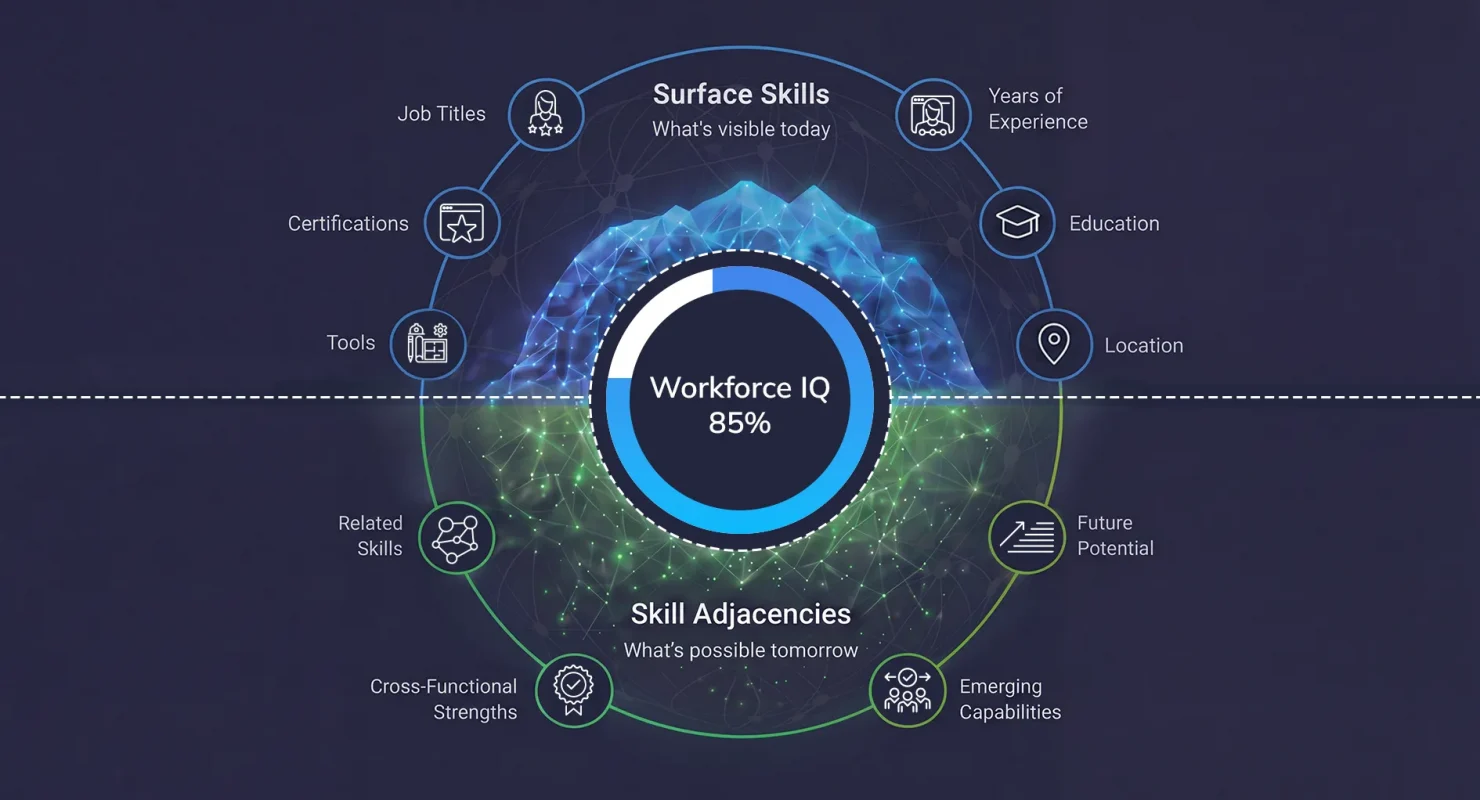
On the surface, the differences between ProFinda and Whoz may not be immediately apparent. Whoz’s all-in-one platform manages staffing, planning, and project operations, helping managers track utilization, margins and delivery in a single system. It suits environments that rely on predictable, repeatable workflows such as IT or engineering. ProFinda, on the other hand, operates as an intelligence layer that improves organisations’ ability to identify and deploy the best-fit talent. Beneath the surface, it offers deeper skills intelligence, stronger support for complexity, and long-term value, as well as security, mass planning, and integration robustness – all indispensable in large, regulation-heavy environments.

Table of Contents
ProFinda vs Whoz: side-by-side comparison:
| Capability area | Whoz | ProFinda |
|---|---|---|
| Primary focus | All-in-one professional services automation and staffing tool | AI-driven skills platform with skills intelligence for expert matches |
| Matching engine | Uses a casting engine focused on availability and sales goals | Ontology built to understand skill adjacencies to identify the best brain for the task |
| Data ecosystem | Centralizes data in a talent cloud | Sits atop existing systems for faster adoption and cleaner data |
| Strategic impact | Optimizes the project | Sophisticated data modeling for strategic workforce planning |
| Workforce visibility | Helps organisations see workforce activity within the platform | Helps organisations understand workforce capability across systems |
| Scalability | Scales effectively within structured professional services environments and defined delivery models | Designed for enterprise scale, highly complex organisations with large, evolving skill ecosystems |
| Deployment | Deployed as a unified platform environment for managing staffing and project coordination | Deployed as an intelligence layer that integrates with existing systems for better decision-making |
What are the key differences between Whoz and ProFinda?
How well is your resourcing platform able to map, deploy and evolve your workforce? Because in this climate, filling roles is just the beginning of the resource management conversation. The real matter is building a more dynamic, adaptive organization – which requires workforce intelligence. You need to know not just who is available, but whether they are well suited to the role and capable of stretching to meet its challenges; as well as what capabilities are missing, or likely to be needed further down the road.
Technology now plays a huge role in helping organisations perform this level of granular forecasting to understand and optimize their workforces’ capabilities. And many leaders are finding that the real crux lies not in the breadth of features a platform offers, but in the depth of its workforce intelligence – particularly once the initial rollout is complete and real-world complexity begins to surface.
How deeply do Whoz and ProFinda understand workforce skills?
While most workforce planning tools are capable of storing skills data, their level of utility depends on how well they understand the relationships between those skills, particularly in complex environments where skills span multiple disciplines. Many describe themselves as AI-driven, but the difference in maturity from one platform to another varies widely. These differences are not always obvious in early demonstrations but become far more visible as organizations scale and data complexity increases.
At the basic “point solutions” level, skills are stored according to taxonomy (by label or category), enabling organisations to optimize individual workflows (Whoz has recently upgraded into ontological territory, but this capability remains in its infancy). This approach may work for straightforward, traditional staffing, but with change as the only constant, it misses important subtleties. Where skills overlap across disciplines, lose or gain currency as demand changes, or are recorded inconsistently, models struggle both to map existing skillsets and to anticipate future needs.
With deeper architecture, ontological mapping is better able to untangle more nuanced data. By mapping the relationships between skills, a robust ontology can help to surface where skills may be transferrable between disciplines and workflows, inferring connections between skills that may not be explicitly listed.
Whoz
Supports skills profiles, CV parsing and matching recommendations to solve specific, narrow operational problems.
Optimized for scheduling, visibility and allocation efficiency within a known structure.
Newly added AI enablement and basic ontology.
ProFinda
Twelve years of machine learning and LLM experience handling complicated workforce datasets ensures that data is linked to context, enabling a richer understanding of how skills evolve over time.
Consideration of skills adjacency and evolution means that capability isn’t tied to job titles. This helps surface optimize resource schedule and allocation that may remain hidden within a less sophisticated architecture.
Which platform delivers better matching for complex resourcing decisions?
A solid match is essential for resourcing decisions – without it projects fail, teams may be incompatible and employee engagement suffers. The more data a matching system considers, the more intelligently it can support optimal staffing and the more it will improve over time. Over time, the value of this depth of capability compounds as the system learns from increasingly complex workforce patterns, rather than relying on static rules.
Rather than matching based on simple availability, job titles or keyword overlap, mature technology drills deeper, taking into account skills relationships, experience signals (such as industries worked in, past success patterns, certifications or performance feedback), employees’ own preferences and planned career trajectories.
Furthermore, an internal talent marketplace can help you hold on to valuable employees. ProFinda’s AI-powered search and match connects people to tasks according to their preferences, enabling self-selection for projects that actually motivate workers — and improving the quality of every resourcing decision over time.
Whoz
An all-in-one administrative suite (including time-tracking) that allows for staffing plans over weeks/months with assigned revenue/costs
Uses a “casting engine” focused on availability and sales goals for assembling project teams quickly.
Adds value in organisations seeking predictable delivery and resource coordination, helping managers to meet utilization targets.
ProFinda
Operates as a specialized intelligence layer, integrating with existing systems and using deeper data to identify the best-fit talent rather than simply allocating available resources
Multidimensional matching logic also takes into account deeper considerations such as skills adjacency, organizational context, employee preferences and track record.
ProFinda’s long-term data maturity strengthens AI recommendations over time for stronger decision support.
Which platform scales better as organizational complexity grows?
Many resource planning software tools work well in contained environments where the skills needed remain reasonably static, like clearly defined projects or individual business units. In larger organizations with fluid demand patterns, however, resourcing needs become significantly more intricate. When organizational complexity grows, seemingly minor limitations in skills matching or modeling become much more visible under real-world complexity. Juggling multiple business units, overlapping skill sets, geographical complexity and internal mobility requires a more advanced system that ramps up performance in pace with the organization. Capabilities that appear comparable at a surface level can diverge significantly under this pressure, particularly around security, integration, and large-scale planning.
Scaling your business isn’t just adding people, it’s also multiplying complexity. As workforce decisions become more interconnected, organisations must wrangle a burgeoning ecosystem of related skills, allocation choices, data sources, constraints and uncertainty. Put simply, matching 200 consultants across five skill categories is manageable. Matching 40,000 employees across hundreds of evolving skills is exponentially harder and it demands a platform built for enterprise-scale resource management.
Whoz
A one-stop shop that manages staffing coordination, margins, billing and project health in professional services environments like IT or engineering
A SaaS template model: quick to deploy, but requiring adaptation of the organization’s unique processes that makes it difficult to support edge cases or complexity later
ProFinda
Particularly strong in audit and similar environments, where mass planning and rapid, skills-based allocation are critical and fine-grained control over permissions and security are a necessity
Proven enterprise-scale deployments supporting very large global workforces with complex compliance and regulatory needs, including EY and KPMG
How do Whoz and ProFinda provide visibility into workforce capability?
At a leadership level, visibility inside a resourcing platform is helpful, but it’s no substitute for visibility across the entire organization. Focusing solely on utilization and availability can obscure capability – the essential ingredient in good workforce decisions.
The problem isn’t a lack of data – most organizations already have a wealth of valuable workforce information – but too often it is fragmented, inconsistent and incomplete. The organic growth of the average business means that employee information is housed everywhere from HR systems to CV databases, project systems, CRM tools and spreadsheets, leaving leaders to rely on partial information and the judgement of others when making tactical staffing determinations.
Data can be consolidated, but when it must be manually imported from one system to another, visibility is inconsistent at best. An AI intelligence layer can eliminate this risk. Rather than replacing existing platforms, it draws information from them and links related data to provide a clear picture of workforce capability and, crucially, any gaps. It doesn’t just consolidate data, it maintains its integrity and usefulness as systems, teams and requirements evolve.
How that visibility is governed also shapes how organizations operate. Some platforms enforce strict approval structures to control who can allocate resources, while others prioritize openness and flexibility, relying on transparency and policy rather than rigid system constraints.
Whoz
Provides a central environment for workforce consolidation, combining employee profiles, project visibility and workforce insight within its unified system.
Includes configurable approval frameworks to control resourcing decisions across teams, supporting organizations that prioritize structured governance and oversight.
ProFinda
Integrates existing HR, CRM and operational systems to build a data network far more valuable than disparate information.
Automatically drawing data from multiple sources, the AI intelligence layer connects fragmented sources to give a 360-degree view of organizational capability.
Favors an open platform approach, where visibility and shared data enable more agile, trust-based decision-making rather than rigid approval barriers.
Which platform is the better fit for your organization?
Ultimately, it boils down to the kind of workforce capability you’re building. No single platform will outperform all others in every respect, so the right fit for you will depend on your organization’s priorities. If your organization needs coordinated, structured project staffing, a consolidated environment for managed delivery and automated budgets, billing and utilization visibility, Whoz is a good bet. But in the current climate, building for the future rather than the present is a no-brainer, and that often means prioritizing depth over surface-level functionality. Investing in capabilities that keep delivering value as complexity increases, rather than those that perform well in initial use cases, makes sense.
Chances are, you need a deeper understanding of your workforce’s capability, both now and tomorrow. At the current pace of change, constantly rebalancing skills is a given, and that requires a more adaptive workforce strategy. You need a platform that thinks around corners and several steps ahead, allows flexibility as skills evolve and emerge, and supports long-term capability planning.
Your Questions, Answered
What is the main difference between ProFinda and Whoz?
While both tools optimize resourcing, Whoz is an all-in-one operational PSA for project billing and scheduling, whereas ProFinda is a deep AI intelligence layer focused on enterprise-scale skills mapping. Whoz uses a “casting engine” centered on availability and sales goals, while ProFinda utilizes a sophisticated skills ontology to understand talent adjacencies and hidden capabilities. Rather than requiring you to consolidate data into a new platform, ProFinda sits atop your existing HR and CRM systems to provide a non-disruptive, 360-degree view of your workforce. ProFinda is specifically engineered for the extreme complexity of global firms like A&M and KPMG, providing the functional depth that standard staffing tools often lack. Ultimately, Whoz is built to manage the project, while ProFinda is built to understand and mobilize the person.
How do ProFinda and Whoz support workforce planning?
Both platforms leverage AI to align people with projects, but they do so at different stages of the planning lifecycle. Whoz offers an operational approach, using a “casting engine” to centralize demand, manage real-time rotations, and optimize activity rates within a unified PSA environment. ProFinda provides a strategic layer, using a proprietary skills ontology to forecast capacity and capability gaps by integrating data across your entire existing tech stack. While Whoz focuses on the immediate efficiency of “filling the bench” and managing project margins, ProFinda models long-term workforce trends and “what-if” scenarios to align talent development with future market demand. Essentially, Whoz helps you plan the work currently in your pipeline, whereas ProFinda helps you plan the workforce you will need for the work that is coming next.
Which platform provides better employee experience?
While Whoz provides a user-friendly interface for managing daily tasks and project schedules, ProFinda offers a deeper, career-centric experience through its AI-driven “Opportunity Marketplace.” Whoz focuses on operational transparency, allowing employees to easily view assignments and log time within a unified environment. In contrast, ProFinda empowers employees by proactively matching them with “stretch” assignments, internal gigs, and learning opportunities that align with their personal career aspirations. ProFinda’s sophisticated skills ontology also reduces resourcing bias, ensuring that talent is identified based on objective capability rather than internal networks. Ultimately, Whoz is designed for a smoother workday, while ProFinda is designed for a more meaningful and mobile career.
How does ProFinda’s talent marketplace differ from Whoz?
Whoz and ProFinda both offer marketplaces to improve internal mobility, but they differ in their primary “matching” philosophy. Whoz operates a project-centric marketplace focused on operational staffing, using its “casting engine” to help managers quickly assemble project teams based on immediate availability and utilization targets. In contrast, ProFinda provides a career-centric Opportunity Marketplace that uses a deep skills ontology to connect employees with gigs, projects, and learning opportunities based on their personal aspirations and skill adjacencies. While Whoz excels at filling roles to meet project margins, ProFinda focuses on democratizing access to work, surfacing “hidden” talent that traditional systems might miss. Essentially, Whoz automates the staffing request, whereas ProFinda automates the match between an individual’s career trajectory and the firm’s strategic needs
Which resource management platform delivers faster ROI?
Both platforms deliver ROI by increasing billable utilization, but they differ in how quickly they reach “break-even” based on their deployment models. Whoz typically requires a centralized data consolidation process, which can lead to a longer implementation tail as you migrate your staffing, billing, and project workflows into their unified environment. ProFinda is designed for “non-disruptive” adoption, sitting atop your existing HR and CRM systems as an intelligence layer to deliver measurable value, often reducing staffing time from weeks to minutes, in as little as a few months. While Whoz generates ROI through long-term operational consolidation, ProFinda accelerates time-to-value by unlocking the latent capacity within your current tech stack. Essentially, Whoz delivers a steady return by replacing your systems, whereas ProFinda delivers a faster return by making your existing systems smarter.
Is ProFinda easier to adopt compared to Whoz?
The key difference in adoption lies in the disruption to your current ecosystem: Whoz is a “platform-centric” solution, while ProFinda is an “intelligence-first” layer. Adopting Whoz often involves a significant change management project to consolidate disparate staffing, billing, and project data into their unified system. In contrast, ProFinda is designed to sit atop your existing HR, CRM, and Finance tools, pulling data from systems like Salesforce or Workday to provide immediate visibility without requiring you to replace them. Because ProFinda doesn’t force you to rebuild your tech stack from scratch, it can often move from integration to impact in weeks rather than the months required for a full PSA migration. Ultimately, Whoz requires you to change how you work to fit their platform, whereas ProFinda augments your existing workflows with a non-disruptive layer of AI intelligence.
Stop scheduling people.
Start optimizing your workforce.
Match the right skills to the right work — automatically. See how AI-drive resource management works in practice.